St John's & Parishes · St John's
St John's on a Saturday: the market and the quays
The market is busiest on Saturday morning, but the waterfront tells more than one story about the capital.
- Parish
- St John
- From St John's
- in town
- Reading
- 3 min
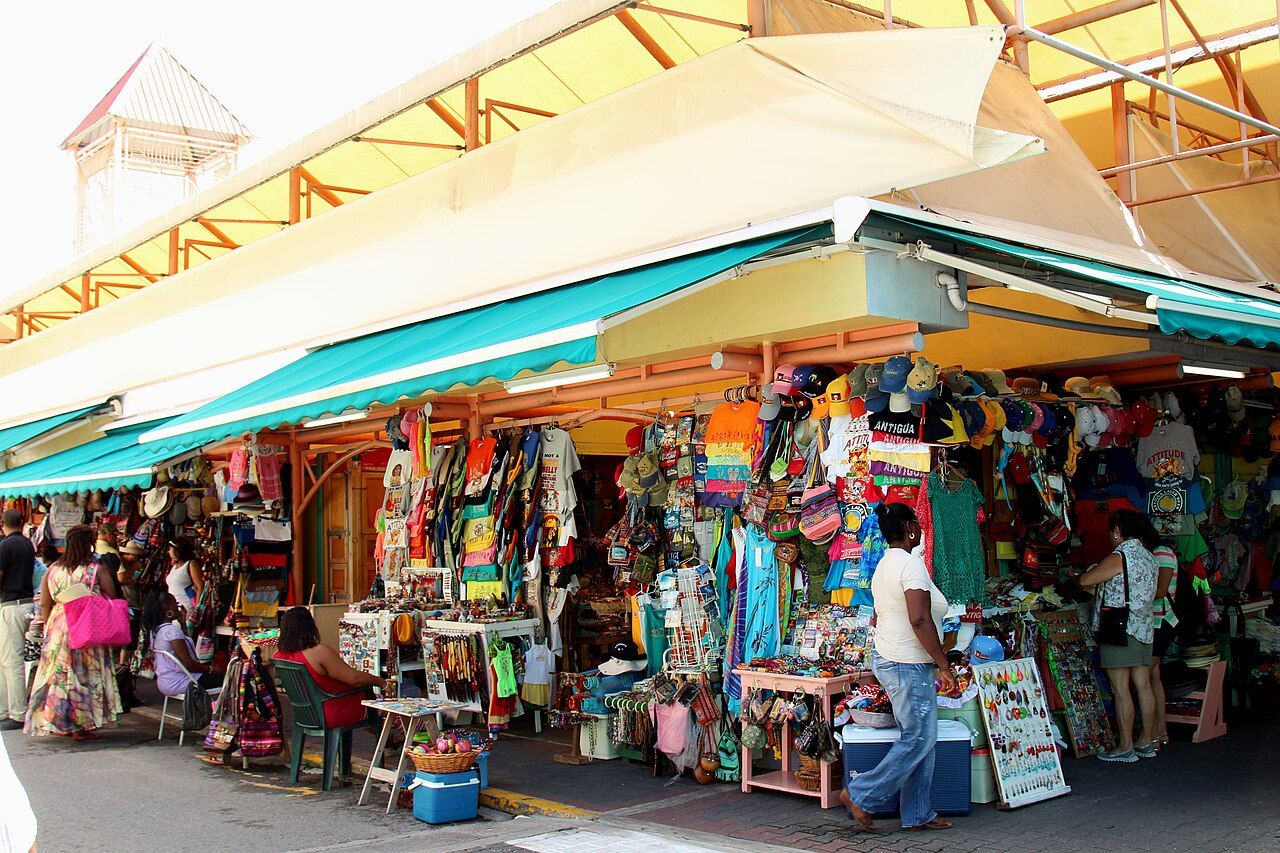
A Saturday morning in St John's has a small contradiction built into it: the public market is at its busiest, while cruise ships berth along the same town's waterfront. That pairing makes a useful starting point for a place that can’t be reduced to one view of the harbor. St John's is the capital and largest town of Antigua and Barbuda, and its streets, market and quays tell different parts of the story.
Myth and fact
Myth: St John's is mainly a cruise-ship waterfront. Fact: The town has a working street plan as well as a harbor. St John's is laid out on a grid of streets running up from the harbor. The waterfront is part of the town, not the whole of it, and the public market is at Market Street's southern end. On Saturday morning, when the market is busiest, that address gives the day another point of focus. The capital is not just a place beside the water; the market and streets are part of its shape, too.
Myth: The market is just a stop to look at. Fact: Its stalls sell local produce and seasonings. Local fruit, vegetables, herbs and spices are sold at the St John's public market. The list is plain, but it gives the market a different character from a waterfront built around ships and restored buildings. Saturday morning is the busiest time there, so the market belongs in any picture of the town that includes the quays. And if the food is the part that catches the eye, it’s also a natural place to start thinking about the island's national dish (without mistaking one market visit for the whole story of it).
Myth: Redcliffe Quay is only a pretty collection of old buildings. Fact: Its history is harder than that. Redcliffe Quay is a group of restored 18th- and 19th-century waterfront buildings. Enslaved Africans were once held there before being sold. Both facts belong in the same account: the buildings have been restored, and the place carries a history that can’t be softened into scenery. A walk through the quays can bring those layers close together, with the waterfront setting and the past attached to the same name.

Myth: Heritage Quay and Redcliffe Quay tell the same story. They’re both on the waterfront, but the facts give them different roles. Heritage Quay is the waterfront area where cruise ships berth. Redcliffe Quay is the group of restored buildings with a history of enslavement as well as a later life as part of the town’s waterfront. It’s worth keeping those names distinct; otherwise, the harbor risks turning into one broad backdrop, when these two places carry different details.
Myth: A town with a harbor is best understood from the water. Fact: The streets run up from it, and many buildings in St John's are wooden, with painted shutters and verandas. That grid offers a simple way to imagine the capital’s layout without making the waterfront the only direction that matters. The market is at one end of Market Street; the quays are along the water. Between them are streets and buildings that make St John's a town, not just a place to arrive by ship.
So what gives the clearest sense of St John's on a Saturday: the busy market, the layered history at Redcliffe Quay, or the grid of streets climbing from the harbor?
The numbers: Parish: St John. The market is in town, at the southern end of Market Street.
Photo credits: Thank You (23 Millions+) views: Creative Commons BY 2.0; CHK46: Creative Commons BY-SA 4.0.

